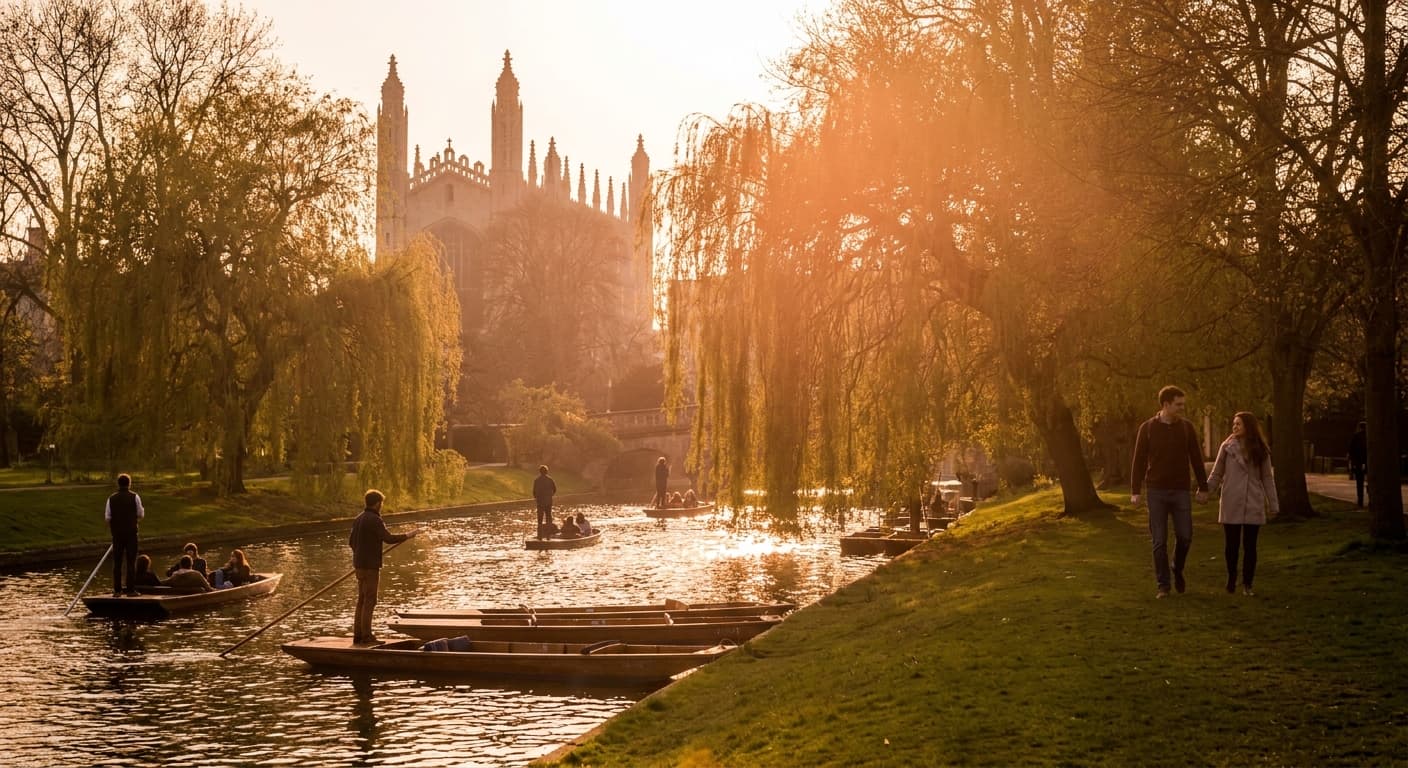
Cambridge has a reputation problem when it comes to romance. From the outside, it looks like a city of sixteen thousand undergraduates, a handful of Nobel laureates, and enough cobblestones to turn every bicycle journey into a mild adventure. The result is that a lot of people who actually live in Cambridge — the nurses, the software engineers, the teachers, the scientists at the biotech park, the people who arrived for university ten years ago and never quite left — assume that the social scene is fundamentally not for them.
This assumption is wrong, and it costs people real opportunities. Cambridge is one of the most genuinely interesting mid-sized cities in England for adults trying to meet someone worth knowing. It is compact enough that the same faces reappear, diverse enough that it is not a monoculture, and young enough in its working population that the social infrastructure has kept up. What it requires is knowing where to look — which means, largely, knowing where the students are not.
Cambridge Without the Gown
The first thing worth understanding about social life in Cambridge is the divide that locals know well: the gown and the town. The university has its own social ecosystem — colleges, formal halls, sporting clubs, union debates, the boat race — that is almost entirely parallel to and separate from the life most Cambridge residents lead. For most of the thirty-odd thousand people who live in Cambridge and are not currently enrolled at either of its universities, that world is invisible.
The second thing is that Cambridge has grown considerably in the last decade. The cluster of life-science and technology companies along the M11 and in the cluster known informally as Silicon Fen has brought in a substantial working population of people in their late twenties, thirties, and forties who are not academic, who socialise in the city's pubs and restaurants rather than college dining halls, and who are often, by self-report, slightly baffled by how hard it is to meet new people in what looks on paper like an extremely sociable city.
That bafflement has a cause. Cambridge's geography concentrates the academic population very visibly in the centre — the tourists, the punting touts, the crocodiles of students on bicycles — while the working population tends to live and socialise slightly further out, in areas like Romsey, Coleridge, Chesterton, and the newer developments to the north and east. The venues that serve these two populations barely overlap. If you are spending your evenings in the pubs immediately around the market square, you are probably in a tourist zone or a student zone. The pubs and cafés where Cambridge locals actually go are a five-minute walk in almost any direction from there.
The Neighbourhoods Worth Knowing
Mill Road and the Romsey Area
If you are going to pick one part of Cambridge to understand for social purposes, pick Mill Road. It is the city's most genuinely diverse street — a long, predominantly independent commercial strip running south-east from the city centre, lined with independent shops, a strong food culture, and pubs that have somehow resisted the standardisation that has hit comparable streets in other English cities.
The people who drink and eat on Mill Road are overwhelmingly local: local in the sense of actually living nearby, not in the sense of being born in the city. A significant proportion of Cambridge's professional and creative class has moved into the Romsey and Coleridge areas in the last decade precisely because Mill Road exists. It is the kind of street where you might find an Ethiopian restaurant next to an independent bookshop next to a real-ale pub that still has a Tuesday quiz night. It is not fashionable in the self-conscious sense. It is just genuinely used.
The Mill Road Winter Fair — held annually in early December — is one of the best street events in the city and draws a crowd that is specifically not the tourist-facing Cambridge. If you want one afternoon in the year to be visible to the full range of interesting Cambridge residents, this is it.
Chesterton and the North
Chesterton has quietly become one of the more desirable residential areas in Cambridge, partly because of its good schools and partly because it has the River Cam running along its southern edge, which gives it a recreational quality that the denser city centre lacks. Victoria Road and the streets around it are now full of the kind of professionals who cycle to work, grow things in their gardens, and attend their local pub with the sort of regularity that makes locals of strangers.
The pub culture in Chesterton is worth knowing: the Fort St George, sitting directly on the river, is one of the few Cambridge pubs where you can reliably encounter people who have been going there for years, which creates the small-community quality that makes conversation easier. The Pike and Eel and the Green Dragon on Water Street round out a riverside walk that functions as a social circuit on warm evenings.
Trumpington and the South
The southern expansion of Cambridge — particularly around the new development at Clay Farm and the established village of Trumpington — has brought in a different demographic: more families, a slightly older professional crowd, people who came for the Addenbrooke's hospital complex and stayed. The social infrastructure here is thinner than on Mill Road, but the people who live here tend to be settled, engaged in the city, and not well-served by the centre's increasingly tourist-heavy venue mix. The Trumpington Arms and the Blue Lion in Cherry Hinton are both worth knowing.
Venues and the Logic of Showing Up
The venues that work for actually meeting people in Cambridge share a few characteristics: they are small enough that regulars become visible, they attract a consistent crowd rather than relying on event traffic, and they give people something to do beyond standing with a drink and hoping.
The Independent Pubs
The Cambridge pub culture that matters for social purposes is not the one on King Street and the streets around it — those are largely student territory. It is the pubs that feel slightly removed from the centre, that do not particularly advertise themselves, and that have kept a regulars' culture through the years.
The Elm Tree on Orchard Street is a good example: small, genuine, focused on real ale, with a crowd that knows each other. The Royal Standard on Newmarket Road draws a similar crowd at a slightly larger scale. The Kingston Arms on Kingston Street, just off Mill Road, has long been the sort of pub where writers, musicians, and researchers mix with local tradespeople, which is the kind of social range that makes a room more interesting.
For anyone new to the city, the practical advice is simple: pick one of these and go regularly. The Cambridge pub that works for you is the one where, after six visits, the person behind the bar knows what you drink.
Independent Cafés
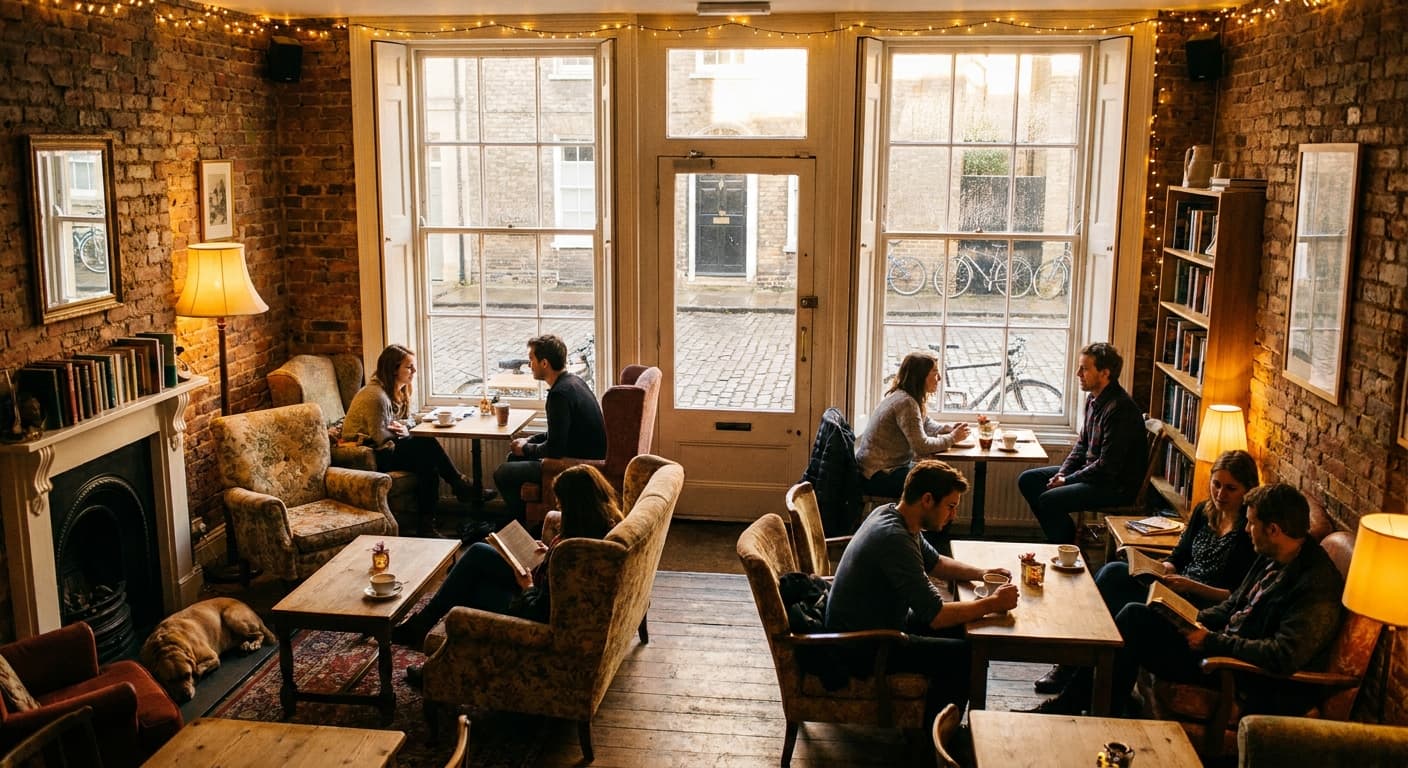
Cambridge has an unusually strong independent café scene, partly because the foot traffic from tourists and researchers sustains a café economy that most cities of this size cannot support. The cafés that matter for social life are the ones with enough seating to linger and enough regulars to make staying feel natural.
Hot Numbers on Gwydir Street — a long-running Cambridge institution — is one of the few cafés in the city that functions as a genuine community space: a coffee shop, a music venue, and a social hub in one. The Espresso Library on East Road has the same quality at a slightly larger scale. Both are worth making a regular stop.
The Craft Beer and Wine Bar Scene
Cambridge's craft beer culture is newer but now well-established. Pint Shop on Peas Hill was one of the first operators to bring a serious natural-wine-and-craft-beer focus to the city, and it still draws a crowd that skews professional and curious rather than student. The Grain and Hop Store on Regent Street has the same quality. Neither requires booking, both are large enough to find space on a weeknight, and both attract the kind of Cambridge resident who is interested in the city rather than just passing through it.
For anyone looking for a first-date venue that is more interesting than a chain restaurant, either of these works well: casual enough not to feel pressured, interesting enough to generate conversation.
Events and the Recurring Logic
The single most reliable piece of advice about meeting people in Cambridge applies to any medium-sized British city: the event you attend twice is worth ten times more than the event you attend once. The city has a strong enough calendar that the raw material is there. The constraint is usually willingness to commit to showing up.
A few recurring events and structures worth knowing about:
Cambridge Junction — the city's main independent music and arts venue, on the new development south of the station — has a programming mix that skews young but not exclusively student. Its bar and foyer culture is the most reliably sociable part of its offer. Going early on a Friday evening and staying through the support act is often a more productive social two hours than the headliner itself.
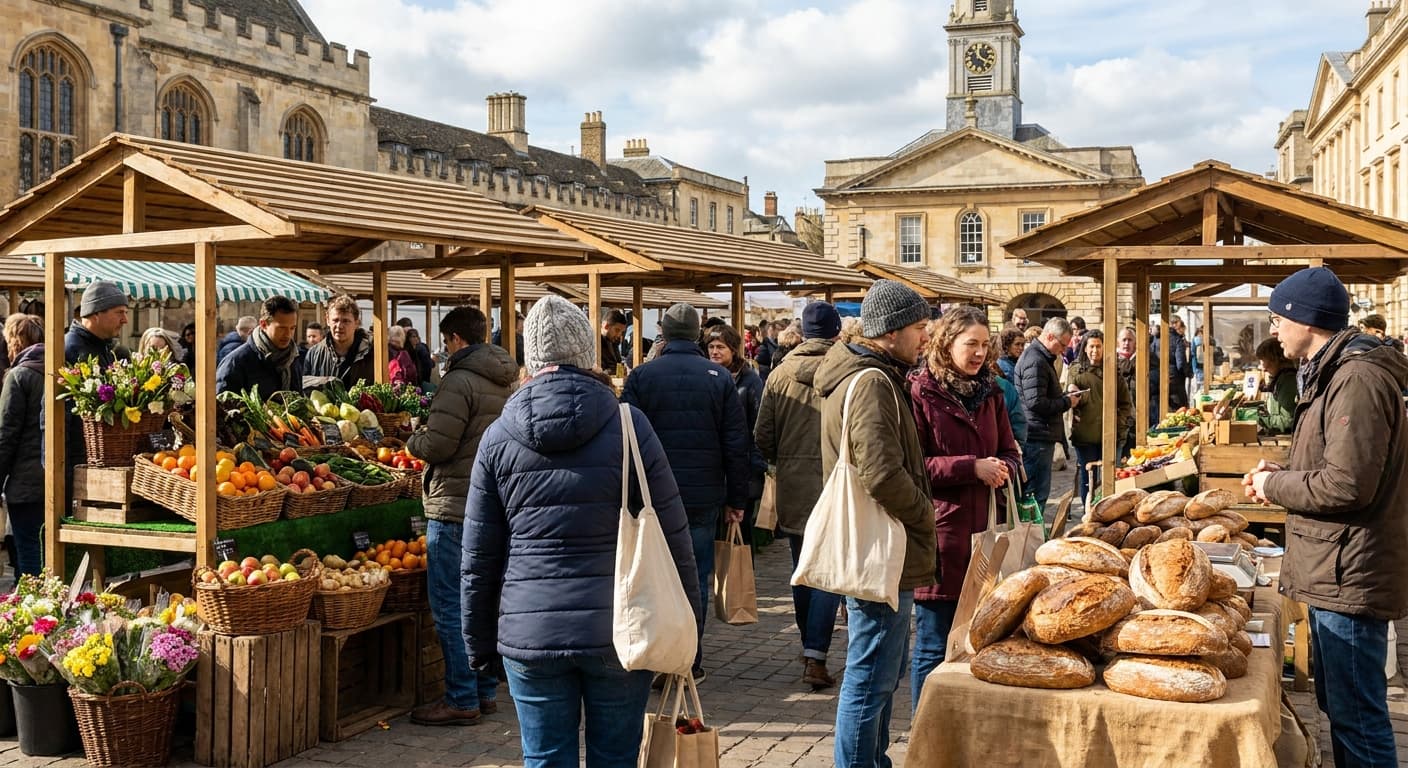
Cambridge Saturday Market — the market on Market Hill has been there for centuries and, unlike many British town-centre markets, still draws a local food-shopping crowd rather than purely a tourist one. Going on a Saturday morning, buying something to eat, and sitting on the market square for half an hour is one of the most effective low-effort social practices available in the city.
Cambridge Arts Theatre and ADC Theatre — both attract a consistent, locally-engaged crowd. Post-show drinks at the Arts Theatre bar are particularly reliable for falling into conversation with people who are there because they are actually interested in what they saw, rather than because it was a birthday outing.
Running and outdoor groups — Cambridge's flat terrain makes running here genuinely pleasant, and the city's running club scene is proportionally large. Cambridge and Coleridge Athletic Club has a strong social side, and the several informal groups that meet near the Cam on weekday evenings attract a working-adult crowd that extends well beyond any university affiliation. The same is true of the cycling community: the Cambridge Cycling Campaign and the various leisure cycling groups that depart from the city centre on weekend mornings are well-attended and well-socialised.
Gig Buddies and social interest groups — Cambridge has a strong culture of adults-only interest groups in music, literature, languages, and outdoor activity. Meetup.com Cambridge, the various independent board game nights (particularly the one at the Haymakers on Kingfisher Way), and the Cambridge Science Festival events in March are all worth investigating if you are newer to the city and trying to build a social base from scratch.
Cambridge's Working Population and Who Is Actually Here
One thing that surprises people who move to Cambridge for work rather than study is the demographic reality. The stereotype is academics and students, but the actual population of working-age adults in Cambridge is considerably more varied. Addenbrooke's and its associated research institutes employ several thousand people in healthcare and biomedical research. The Biomedical Campus south of the city is one of the largest clusters of life-science employment in Europe. ARM, Amazon, AstraZeneca, and scores of smaller technology and pharmaceutical companies have a permanent base in or near the city.
The result is a working population that is unusually international by English standards, skews slightly younger than the national average, and — a point worth making plainly — is often quite difficult to meet because it has not worked out where to go yet. Many of the people in Cambridge who are single and looking to meet someone are relatively new to the city, arrived for a job rather than a social life, and are slightly lost in a city whose social geography is genuinely difficult to read at first.
This is useful context if you are in a similar position. The people you are trying to meet are not hidden or inaccessible. They are in similar situations: in a city that is interesting and compact and full of smart people, unsure of which rooms to walk into.
Dating Online in Cambridge
For most single adults in Cambridge under forty, online dating is now the normal route to first dates. The apps — Hinge, Bumble, Feeld, and a longer tail of niche services — have a reasonable critical mass in the city. Cambridge is large enough that running out of profiles is not an immediate problem, but small enough that you will start recognising faces after a few weeks of active use. This is, after a short period of awkwardness, mostly useful: it means the pool is made up of people who are genuinely local and genuinely looking, rather than a sprawling population with no geographic coherence.
A few things are specifically worth knowing about using dating apps in Cambridge.
The student population distorts the age distribution. Most of the major apps will surface a significant number of profiles belonging to current students, particularly in term time. If you are a working adult looking to meet other working adults, adjusting your age filter accordingly is worth doing, not out of snobbery but out of practicality: a 21-year-old in their final year of a degree and a 31-year-old in the second year of a software role are at very different stages of life, and a date between the two is often more confusing than rewarding.
Geography is tight but real. Cambridge is a small city in absolute terms, and the practical travel question — can we meet somewhere central without it being a major effort? — almost always has a yes answer. But suggesting a venue well outside the centre for a first meeting adds a small but real friction. Somewhere on or near Mill Road, around the station, or in the Grafton area is almost always convenient for both sides.
Free platforms can work better in smaller cities. The swipe-based economics of the major apps work better in cities with very large user populations: London, Manchester, Birmingham. In Cambridge, the finite-pool dynamic arrives faster, which can produce a particular kind of exhaustion — the sense that you have seen everyone already — well before you actually have. Platforms that approach connection differently, like iwillfindyou.love, which removes the paywall on messaging and prioritises genuine conversation over infinite swiping, tend to perform relatively well in mid-sized cities where depth of engagement matters more than volume.
Move from online to in-person relatively quickly. Cambridge first dates are easy to arrange: the city is compact, the venue options are good, and the walking distances are short. A week or two of online messaging followed by a suggestion to meet for a drink on Mill Road or a coffee near the station is a reasonable pace. The longer the conversation stays online, the more likely it is that scheduling entropy ends it before it begins.
A Week That Works
If you wanted to design a week in Cambridge that quietly put you in good proximity to interesting people, it might look like this:
-
Tuesday evening: A quiz night or a gig at one of the smaller venues — Cambridge Junction, the Portland Arms on Chesterton Road, the Hidden Rooms jazz bar in the basement on St Edward's Passage. Something recurring that you could plausibly do again next week.
-
Wednesday morning or lunch: Hot Numbers or the Espresso Library with a book or a piece of work. Not as preparation for meeting someone, but as a practice of showing up to a place you enjoy in a way that makes you visible.
-
Thursday after work: A Pint Shop or Grain and Hop Store weeknight drink, either alone or with a colleague or friend you are willing to introduce to other people.
-
Saturday morning: Market Hill, Whole Foods on Trumpington Street, or the Saturday Cambridge Farmers' Market when it runs. Slow, local, full of people with no particular schedule.
-
Sunday: A river walk from Grantchester Meadows back into the city, or a cycle along the towpath towards Ely. The kind of activity that is pleasurable regardless of outcome and that happens to put you in the same landscape as a lot of other Cambridge people spending their Sunday well.
None of this is a formula. It is an illustration of a principle: the Cambridge social life that produces the conditions for meeting someone is not built on a single venue or a single app. It is built on the slow accumulation of small presences in places you genuinely want to be, sustained over months rather than weekends.
Finding Your Footing
Cambridge can feel, initially, like a city that already has its social world sorted — and for the people whose social world is the university, it does. But the rest of the city is, in many ways, more open than it appears. It is full of people who arrived recently, who are still figuring out which pub is theirs, which market is worth the early Saturday start, and which part of the Cam they prefer on a summer evening.
The practical advice is the same as it would be in any mid-sized English city with a compact geography: pick two or three places you genuinely like and show up to them with enough regularity to stop being a stranger. The city is small enough that this starts working faster than you would expect.
iwillfindyou.love is built to make the online half of this easier — a platform where messaging is free, where the focus is on genuine connection rather than algorithmic engagement, and where you can find people who are actually based in the city and actually looking to meet. Cambridge is a good city for this. It rewards people who take it seriously as a place to live rather than as a backdrop.
Further Reading
-
Robert D. Putnam. Bowling Alone: The Collapse and Revival of American Community. Simon & Schuster, 2000. An enduring study of how community infrastructure shapes the ease with which people form new social connections — applies directly to understanding why some neighbourhoods produce dating opportunities and others do not.
-
Office for National Statistics. Population Estimates for UK, England and Wales, Scotland and Northern Ireland. https://www.ons.gov.uk. Baseline demographic data for understanding the composition of Cambridge's working-age population and household structures.
-
Cambridge City Council. Cambridge Local Plan 2018. https://www.cambridge.gov.uk. Useful context for understanding the housing and population growth that has shaped the contemporary social geography of the city.
-
Sherry Turkle. Reclaiming Conversation: The Power of Talk in a Digital Age. Penguin Press, 2015. On the relationship between digital communication habits and face-to-face connection — relevant for anyone thinking about how to balance online dating with building a real social life in a place like Cambridge.