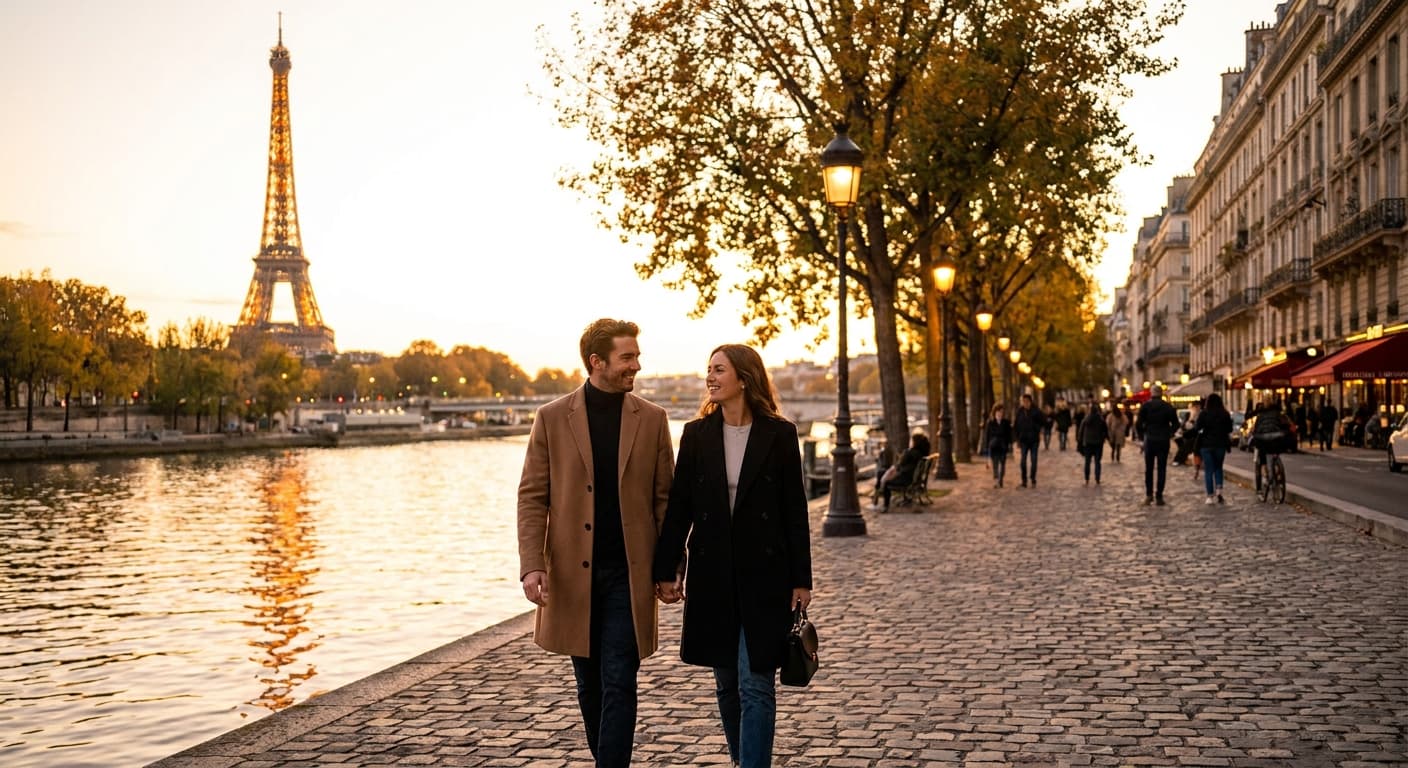
Paris is, by reputation, the most romantic city on earth. The problem with reputations is that they attract a particular kind of visitor — one who arrives expecting the romance to be waiting for them on the banks of the Seine, or at a café table, or at a candlelit dinner with a view of the Eiffel Tower. The city is extraordinarily good at delivering that version of itself. It has had centuries of practice.
But the Paris that belongs to people who live here, the city beneath the postcard surface, works rather differently. It is more private, more particular, and in some ways more demanding than the romantic mythology suggests. It is also, for people willing to engage with it on its own terms, far more genuinely interesting.
This is the guide for those people: the ones who have moved to Paris, or are considering it, or who have been here long enough to realise that something about the social landscape is harder to navigate than they expected — and who want to understand why, and what to do about it.
Why Romance in Paris Is Not What Most People Expect
The first thing worth understanding about Parisian social culture is that it is fundamentally relationship-based rather than encounter-based. This is a meaningful distinction. In cities like London or New York, social life tends to have a high-churn, encounter-heavy quality — you meet people at events, at bars, at parties, and the assumption is that proximity plus a positive first impression is sufficient for something to develop. Paris does not work this way.
Parisians, as a general rule, have small and tight social circles that they invest in deeply. The concept of making new friends — or meeting a romantic partner — through a single encounter is not absent from French life, but it is not the primary mode. More commonly, the people who become important to Parisians do so because they have been encountered repeatedly over time: through friends of friends, through shared activities, through workplaces, through the recurring fabric of daily life.
This means that the standard Anglo-American strategy of "going out and meeting people" tends to produce disappointing results in Paris. Going out is necessary but not sufficient. What matters is not the single outing but the pattern — the accumulation of familiar faces, the gradual transition from stranger to recognisable presence to trusted acquaintance.
For someone who has recently arrived in Paris, or who has been here for a while without quite cracking the social code, this is the central piece of reorientation required.
The Tourist Trap — and How to Avoid It
Paris is one of the most visited cities in the world, and a significant portion of its geography, economy, and social atmosphere is organised around that fact. The result is that a large part of the city that is most visible to newcomers — particularly newcomers who arrive without language skills or local contacts — is essentially a tourist-facing overlay. The bars around Saint-Germain-des-Prés, the restaurants on the Île de la Cité, the crowd-pleasing areas around the Marais that show up on every recommendation list: these are places designed to be experienced by people passing through, and the social atmosphere reflects that.
This does not mean these areas are bad. It means they are not where a romantic life in Paris is built.
The Paris where people actually live — the city of neighbourhood boulangeries and local café regulars and wine bars where the same faces appear week after week — exists mostly east and north of the postcard centre. The 10th, 11th, 18th, and 19th arrondissements have a density of real, lived Parisian life that the tourist-facing areas cannot match. This is where the social infrastructure for sustained connection exists: the local café where the owner knows your order, the evening pottery class where the same ten people have been coming for three months, the Sunday market where you buy cheese from the same vendor every week.
Investing in these areas — spatially, temporally, habitually — is the single most effective thing a newcomer can do to build the social conditions for meeting someone real.
The Language Question
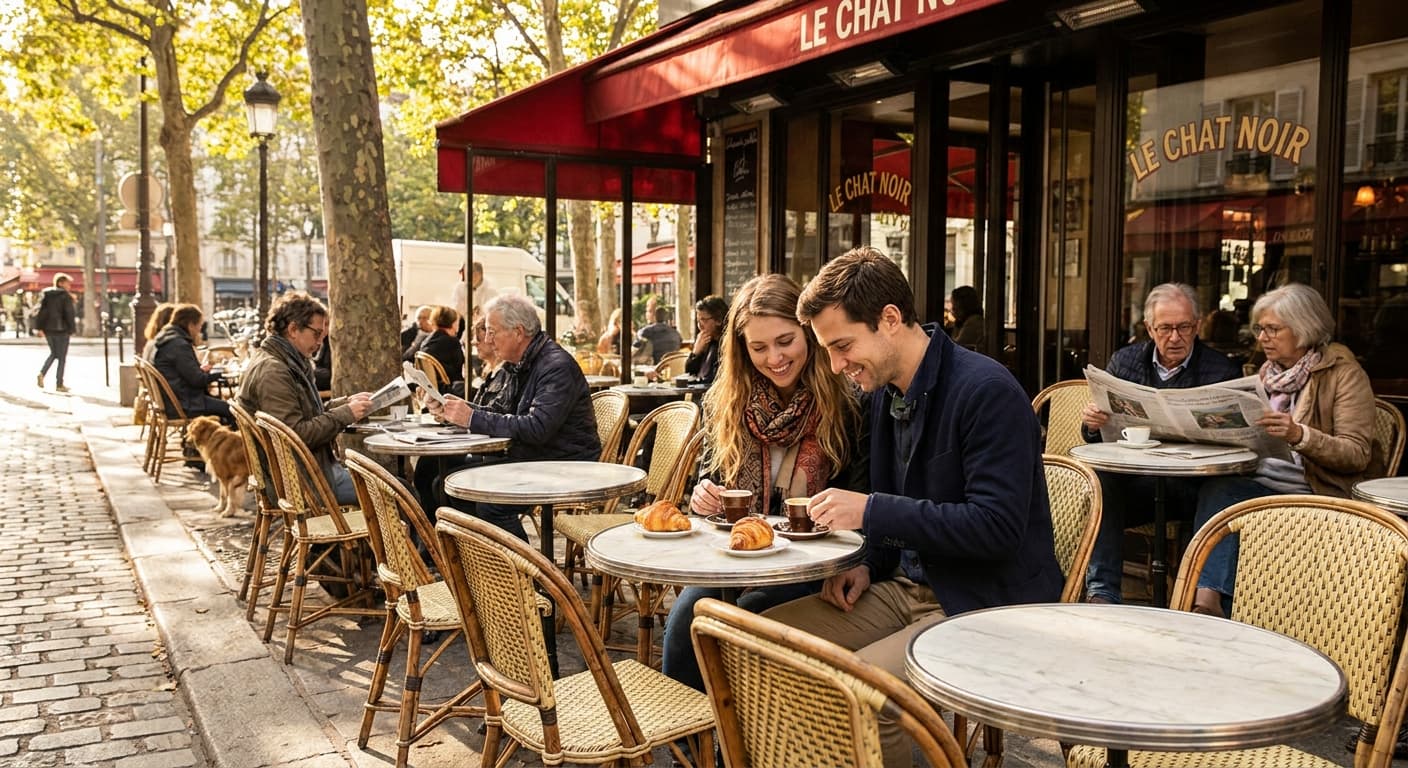
There is no way to write honestly about dating in Paris without addressing French. The relationship between language and social access here is more significant than in most European capitals, not because Parisians refuse to speak English — many do, and well — but because the social signal sent by speaking French, even imperfectly, is powerful.
In France, language is closely tied to cultural participation. Speaking French communicates, at a basic level, that you are here for real — that you have engaged seriously with where you are rather than treating Paris as a backdrop to your existing life. Parisians who have encountered a steady stream of English-speaking visitors who never learn a word of French tend to be sceptical of foreigners in ways that are hard to articulate but easy to feel.
This scepticism melts quickly in the presence of genuine effort. You do not need to be fluent. You need to be willing — to try, to make mistakes, to laugh at yourself, and to demonstrate by your language choice that you have invested in the place you have chosen to live. Even a basic functional level of French — enough to order, to apologise, to hold a short conversation — opens doors that are firmly closed to people operating entirely in English.
If you are not there yet, a language class is worth taking not primarily because you will learn French there (though you will), but because it will put you in a room with other people who are trying. French language classes in Paris — particularly the better-known ones at the Alliance Française or at any number of independent schools — are one of the most reliable social environments in the city for meeting people who are genuinely interested in integrating rather than simply existing in the tourist layer.
Where Parisians Actually Go
Understanding the geography of Parisian social life is more useful than any list of specific venues, because the city changes and the venues matter less than the principle.
Neighbourhood wine bars. The Parisian cave à vins — the small, usually neighbourhood-specific wine bar that focuses on natural wine and serves straightforward food — is one of the primary social venues for people in their late twenties and thirties who are neither students nor fully settled. These are the bars where regulars become regulars by returning, where the proprietors are usually interesting people worth talking to, and where the atmosphere lends itself to conversation rather than performance. The 11th arrondissement has a high density of these; so does the Batignolles area in the 17th and the Canal Saint-Martin stretch of the 10th.
Markets. The covered and open-air markets of Paris function as genuine community infrastructure in ways that supermarkets do not. The Marché d'Aligre, the Marché des Batignolles, the Marché Beauvau — these are places where the same vendors and the same customers see each other weekly, where conversation is expected and easy, and where the format naturally accommodates getting to know someone over time rather than in a single encounter.
Cultural life. Paris has an exceptionally rich cultural infrastructure — cinema, music, art, lecture, literary events — and a population that takes culture seriously. Events at venues like La Gaîté Lyrique, the Centre Pompidou, and the city's hundreds of independent cinemas and galeries draw exactly the demographic most likely to be both interesting and open to connection. The format of these events — particularly anything with a social component after, or that involves a recurring programme — makes repeated encounter possible.
Sports and outdoor life. The parks of Paris, particularly the Bois de Vincennes and the Canal Saint-Martin area, have thriving running and outdoor sports communities. Paris Rando, the various parkrun equivalents, Sunday football groups, cycling clubs: these communities are not typically thought of as romantic infrastructure, but they are exactly the kind of recurring activity that creates the familiarity and regular contact from which Parisian connections tend to grow.
How Online Dating Works in Paris
France has one of the most active online dating markets in Europe, and Paris is no exception. The major platforms all have significant French user bases, and online dating carries none of the social stigma it once did — it is simply a mainstream route to meeting people, used by all age groups but particularly by those in their twenties and thirties.
What is distinctive about dating apps and sites in Paris is the behavioural pattern they tend to attract. Parisian users are, as a general rule, more deliberate and less volume-driven than in London or New York. The number of matches on any given platform tends to be lower, and the conversion from match to actual meeting is also lower in raw volume terms — but the people who are engaging are, typically, engaging seriously.
This means the high-frequency, low-investment messaging approach that functions adequately in high-volume markets performs poorly here. A short, impersonal opening message will typically be ignored. A message that demonstrates genuine curiosity — that references something specific in someone's profile, that asks a real question, that shows actual engagement with the person rather than the format — performs considerably better.
It also matters, practically, whether the platform imposes paywalls on messaging. French users are often unwilling to pay for the ability to respond to someone who contacted them first, which creates a frustration dynamic on platforms with asymmetric payment requirements. Platforms that allow full messaging without subscription barriers — like iwillfindyou.love — remove that friction, which matters particularly in a market where conversation takes time to develop.
Honesty about your situation is worth emphasising here as it is offline: French people, and Parisians in particular, tend to respond badly to managed self-presentation. Being direct about who you are and what you are looking for, including any limitations of your situation (your French level, your timeline in the city, your uncertainty about what you want), is generally better received than a polished but slightly fictional version of yourself.
French Romantic Culture — What to Actually Expect
There are several features of French romantic culture that are worth knowing about before you encounter them and misread them.
The absence of the explicit "date" framing. In British and American romantic cultures, a "date" is typically a clearly signalled event with an explicit romantic purpose — both people know they are on a date, and there is a shared understanding of what that means. France does not really have this convention. What functions as a first date in French culture is more likely to be framed as two people meeting for a drink, with no explicit romantic label attached. This does not mean there is no romantic intent — there often is — but it is expressed indirectly. The shift from "meeting up" to something clearly romantic tends to happen through the accumulation of these encounters rather than through any single moment.
Directness about attraction. This might seem contradictory given the above, but within what might be understood as a romantic context, French culture is considerably more direct about attraction than British culture in particular. Once it is clear that there is mutual interest, French people tend to be less squeamish about expressing it. The indirectness is in the framing of the encounter; the directness is in the expression of feeling once the encounter is established.
The importance of conversation. This is perhaps the most reliable generalisation one can make about French romantic culture: conversation matters enormously. The ability to hold a real conversation — to have opinions, to engage with ideas, to listen, to push back, to be genuinely interesting — is valued more explicitly here than in most Anglophone contexts. Physical attraction matters, as it does everywhere, but the French emphasis on séduction intellectuelle is not a myth. Bringing something real to a conversation — your own perspective, your own curiosity, your own preoccupations — is the most reliable thing you can do to make a genuine impression.
The Neighbourhoods Worth Your Time
If you are choosing where to live or where to spend your social time in Paris, the arrondissement you pick matters.
The 11th remains the neighbourhood most associated with the kind of young professional social life that has organic mixing, unpretentious bars, and a high density of people in their late twenties and thirties who are neither tourists nor finance workers. It is accessible, affordable by Parisian standards, and socially rich in ways that reward investment.
The 10th — particularly the Canal Saint-Martin corridor — has a similar demographic but with a slightly younger and more design and arts-adjacent tilt. The waterway itself functions as a public living room in warm weather, with groups gathering on the quayside in patterns that are remarkably sociable.
Belleville and the 20th have a more diverse, artistic, and politically engaged population that is less self-consciously fashionable than the Canal areas. The social atmosphere here rewards genuineness and punishes performance, which is either appealing or challenging depending on your instincts.
The Marais deserves mention because, despite being heavily gentrified and tourist-adjacent, it remains one of the best neighbourhoods in the city for the LGBTQ+ community, with a social infrastructure that is genuinely community-based rather than purely commercial.
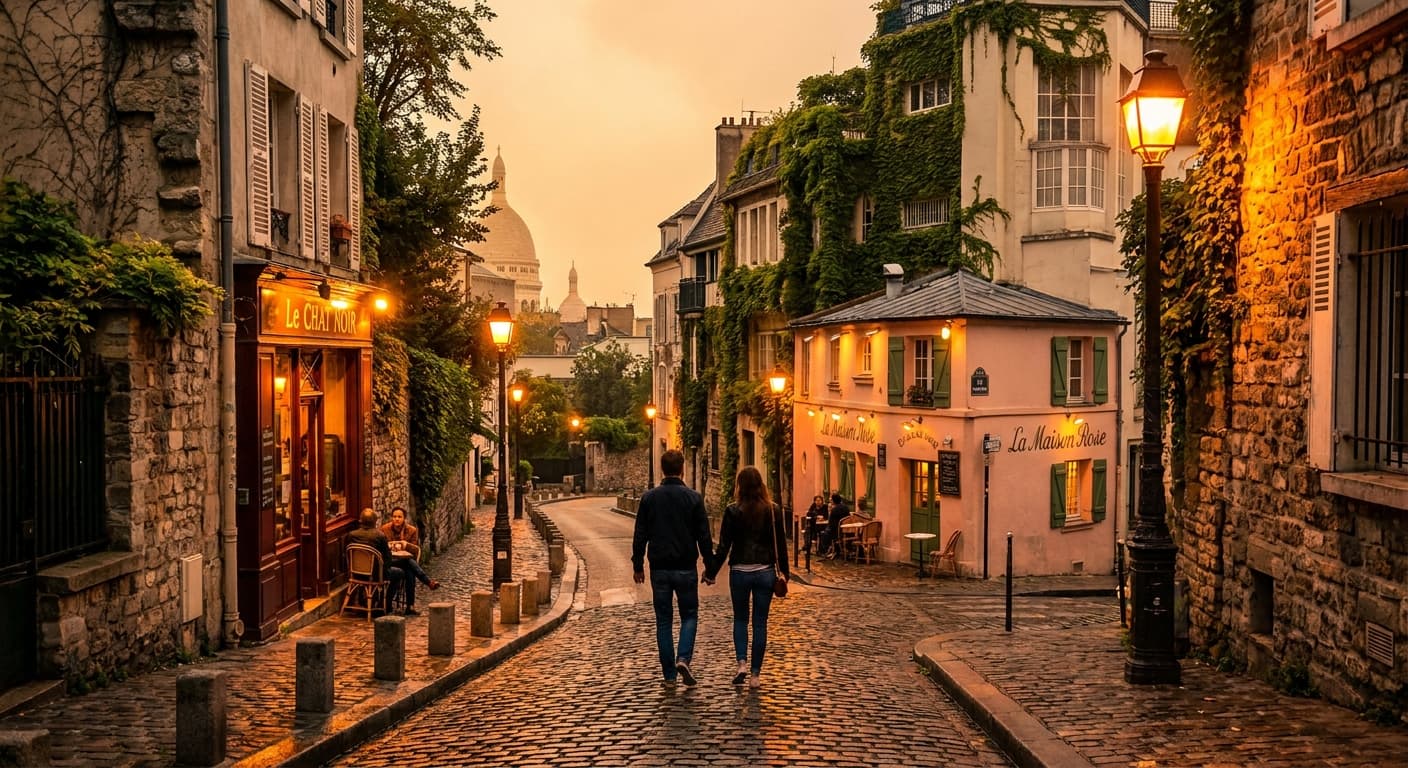
Montmartre and the 18th have a reputation for romance that is partly deserved, particularly in the streets around the Abbesses metro station and the quieter residential areas north of the Sacré-Cœur. The neighbourhood has resisted becoming purely touristic more successfully than most of the historic centre, and the community of people who live there is genuinely rooted.
Building the Conditions for Connection
The honest meta-lesson from all of this is that Paris rewards investment. The city has a social depth that takes time to access and a cultural richness that requires language and repetition to absorb. People who treat their time here as temporary — who live in the tourist layer, who operate in English, who use Paris as a backdrop rather than a place — tend to have a pleasant time that leaves them feeling somewhat at a distance from the city they actually live in.
People who invest — who learn French, who become regulars at particular places, who build relationships through repetition rather than event, who engage seriously with what Paris actually is rather than what they imagined it would be — tend to find that the city opens in ways they did not expect. The social circles that seemed closed turn out to have doors. The connections that seemed impossible to make start to feel natural. The romantic life that seemed to belong to a film becomes, gradually, the life being lived.
This is not a quick process. Most people who engage seriously with Parisian social life report that it takes six to twelve months before it starts to feel genuinely embedded. This is longer than most people expect and shorter than most people fear, and it is a reasonable investment for a city that, under the postcard surface, is among the most interesting places on earth to be.
iwillfindyou.love is a free-to-message dating platform with users across Europe, including Paris. You can message anyone from day one without needing a subscription.
Further Reading
-
Gilles Lipovetsky. The Empire of Fashion: Dressing Modern Democracy. Princeton University Press, 1994. An indispensable account of French consumer and social culture by one of France's leading sociologists — provides essential context for understanding the relationship between self-presentation, authenticity, and social approval in Paris.
-
Mireille Guiliano. French Women Don't Get Fat. Knopf, 2004. More sociological document than diet book: Guiliano's account of French attitudes toward pleasure, restraint, and everyday life illuminates the cultural assumptions that underpin French romantic sensibility.
-
Agnès Poirier. Left Bank: Art, Passion, and the Rebirth of Paris 1940–50. Bloomsbury, 2018. A richly researched account of Parisian intellectual and social life at its most intensely romantic — useful for understanding the historical roots of the French emphasis on conversation, ideas, and intellectual séduction in romantic life.
-
Polly Platt. French or Foe? Getting the Most Out of Visiting, Living and Working in France. Distribooks, 1994. The practical companion to cultural misunderstanding for English-speaking arrivals: blunt, accurate, and genuinely useful for anyone trying to understand why social life in France works the way it does.
-
David Lebovitz. The Sweet Life in Paris. Broadway Books, 2009. A food writer's account of relocating to Paris and navigating the social culture as an outsider — warmer and more personal than a cultural guidebook, and more useful than most of them.