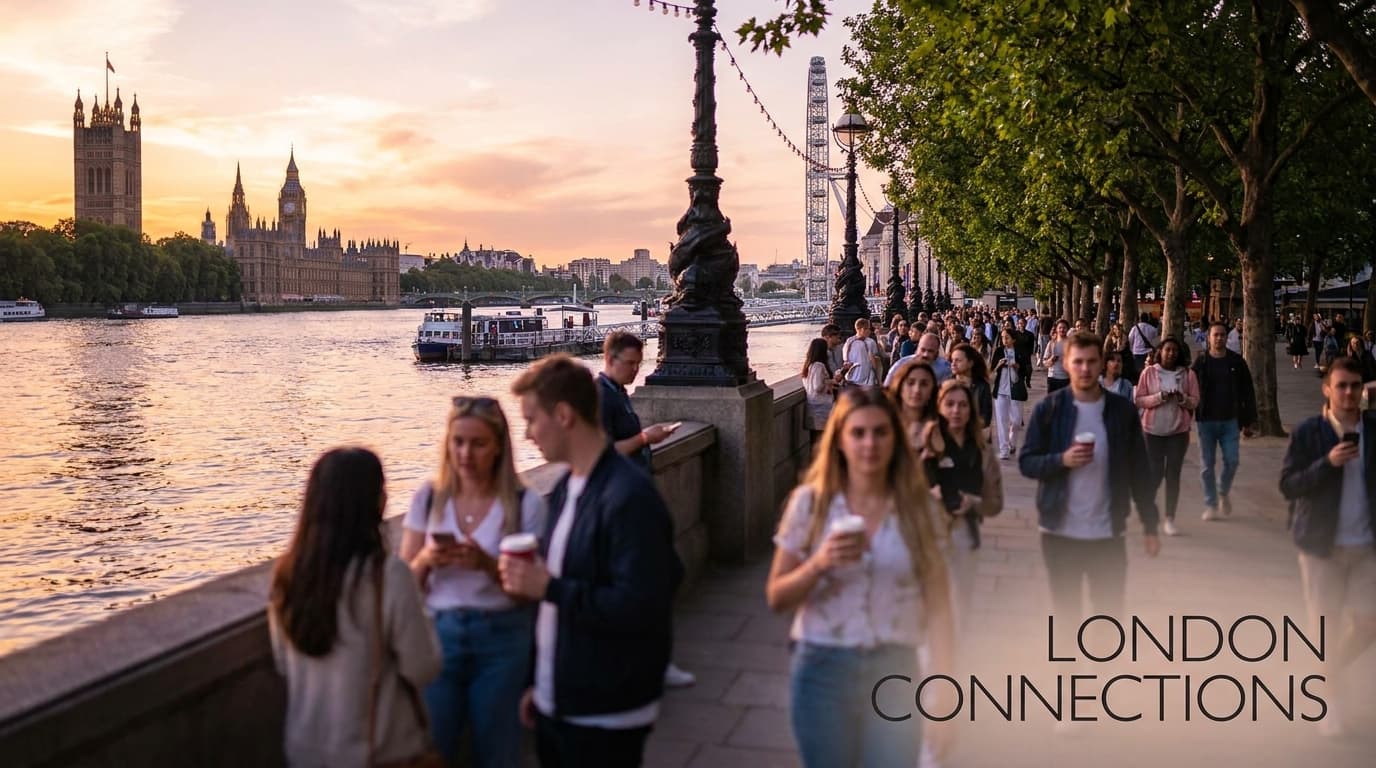
London is one of the easiest cities in the world to live in alone, and one of the hardest to actually meet someone in. With nine million people moving past each other on the Tube, the Overground, the buses, and the pavements of the City and the West End, the maths of dating here ought to be straightforward. In practice, the maths is the problem. Choice is abundant. Time is scarce. Most evenings end with a delivery and a sofa rather than a slow drink in a corner pub.
If you have lived here for any length of time, you already know the standard answers — Hinge, Bumble, run clubs, climbing walls — and you already know how thin those answers can feel after a few months of swiping or signing up for an activity you never quite finish. This guide is for the longer view: the neighbourhoods, venues, weeknight habits, and online practices that actually put Londoners in the same room as each other, and the small adjustments that turn that proximity into something more.
How Dating in London Actually Works
The first thing worth saying is that London is not really one dating scene. It is dozens. Soho on a Friday and Stoke Newington on a Sunday belong to two different cities. A weeknight at a co-working dinner in King's Cross does not overlap with a Saturday morning at Columbia Road Flower Market. Choosing where you spend your unstructured time is more or less choosing who you bump into. People who treat London as a single undifferentiated pool tend to find dating here exhausting. People who develop a small set of routines in places they actually like find their odds quietly improving.
The second thing is that proximity is everything. Londoners are time-poor, and a first drink that requires a 45-minute Overground trip is a drink that probably will not happen. The single biggest lever in your London dating life is whether the people you want to meet live and socialise within twenty minutes of you. Online or offline, the geography of your week matters far more than most apps acknowledge.
The third thing is that the city is genuinely transient. A significant share of the people you meet will leave within two years, either back to their home country or out to commuter belts like Reading, St Albans, or Sevenoaks. This is not a reason to hold back — but it is a useful piece of context when you are trying to understand why a connection that felt promising suddenly evaporated. It is often the city, not you.
Neighbourhoods That Quietly Work
Some parts of London are famous for their dating reputation. Most of those reputations are out of date. Here is a more honest neighbourhood-by-neighbourhood read.
Soho and Fitzrovia
Still the centre of the city's after-work life, but more grown-up than its 2010 reputation suggests. The crowd in Soho on a Wednesday is now mostly thirty-somethings in advertising, post-production, tech, and law, decompressing in the same wine bars and small restaurants their twenty-year-old selves used to peer into. Fitzrovia is its quieter, more residential neighbour — the bars and pubs around Charlotte Street and Goodge Street have the kind of crowd that actually talks to strangers, partly because they live nearby and partly because the rooms are small enough that nobody can pretend they are alone.
Shoreditch and Hackney
The hype has cooled, which is what makes them more interesting again. The serious noise has moved further east to Hackney Wick and Walthamstow, leaving Shoreditch as a slightly older, slightly more settled neighbourhood with strong weeknight pub culture. Broadway Market on a Saturday is one of the easier places in London to fall into a conversation with someone you have never met. London Fields in good weather has the same quality, with the added pleasure of dogs to talk about.
Bermondsey and London Bridge
One of the city's quietly underrated areas for adult social life. The Bermondsey Beer Mile draws a curious, conversational crowd on weekend afternoons. Maltby Street Market is small enough that the same people come back, which makes it easier to actually meet someone rather than just walk past them. Tower Bridge Road and the Tanner Street area have a steady, unflashy local scene that rewards people who show up regularly.
Clapham, Balham, Tooting
The classic South London commuter belt. Long ridiculed as a kind of post-university holding pen, the area has quietly matured. Tooting in particular has become genuinely interesting in the last few years — its markets, Bangladeshi and Sri Lankan restaurants, and small bars draw a more eclectic crowd than the area's reputation suggests. The Hope on Wandsworth Common and the Bedford in Balham remain reliable for low-pressure weekend afternoons.
Stoke Newington and Highbury
Often described as the unofficial capital of single thirty-somethings in North London. Church Street on a Saturday is one of the few stretches of pavement in the city where you can genuinely spend an afternoon and assume you will run into people. Clissold Park has a similar quality. Highbury Fields and the bars around Highbury Barn fill the same role for slightly older crowds.
Notting Hill, Ladbroke Grove, and Westbourne Park
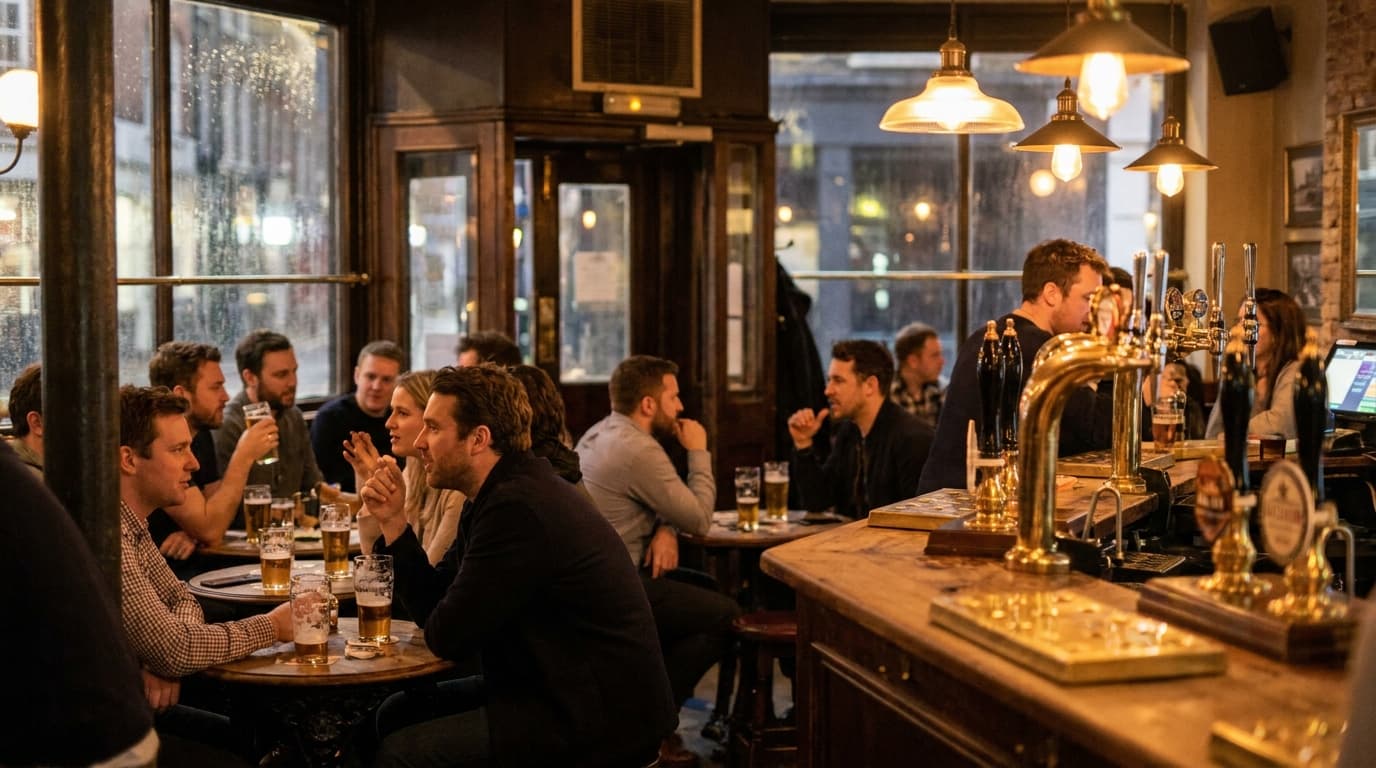
Quieter than they used to be in dating-app terms, but more interesting than the postcard image suggests. The Cow on Westbourne Park Road, the Pelican on All Saints Road, and the Sun in Splendour all reliably attract people who actually live in the area rather than tourists. Portobello Road on Saturday morning is a market in the literal sense and a market in the social sense — go early, before the crowds, and the people behind the stalls and in the cafés know each other.
Crystal Palace, Peckham, and the South-East corridor
If you are dating in your thirties and you have not yet looked at south-east London seriously, it is worth a weekend afternoon to see why so many people have moved there. Peckham's bar scene has settled into something more mature than its reputation. Crystal Palace has a slow, neighbourhood-y character that makes meeting people easier. Forest Hill and Honor Oak are quieter still, with cafés and small pubs where strangers actually become regulars.
Venues That Reliably Bring People Together
Beyond neighbourhoods, certain types of venue do disproportionate work in this city. They are worth thinking about not as places to "go on the pull", which almost never works in London anyway, but as places where it is possible to be a regular and gradually become part of a small community of people.
Independent cafés with seating you can linger at
Climpson and Sons in Broadway Market. Workshop in Clerkenwell. Monmouth at Borough. Kiln in Soho. Bar Termini for a stand-up espresso that turns into a stand-up conversation. The common thread is small spaces, good coffee, and staff who recognise you after the third visit. This is one of the most underrated dating-life decisions in London: pick two or three cafés in your immediate neighbourhood and actually become a regular at them.
Pubs with a Sunday roast culture
The Camberwell Arms. The Eagle in Farringdon. The Anchor and Hope on the Cut. The Pig and Butcher in Islington. Sunday lunch in London is a quietly social occasion in a way the city does not always advertise. Tables are close together, lunches stretch into late afternoons, and rooms warm up over hours rather than minutes.
Independent cinemas and arts venues
The Prince Charles in Leicester Square. The Rio in Dalston. The Castle in Homerton. The Garden Cinema in Holborn. Picturehouse Central. These places have bars attached, programmes that draw a curious crowd, and an audience that often arrives early and stays late. Going to a screening alone is genuinely fine in London and surprisingly often leads to incidental conversations.
Run clubs, climbing walls, and bouldering
The infrastructure here is now serious. Midnight Runners, the November Project, Run Dem Crew, and the various pace-group offshoots have made running socially central in a way it was not five years ago. The Castle in Manor House, VauxWall, the Arch Climbing Walls — climbing's social density is high because the activity itself requires you to talk to strangers. The point is not to attend in pursuit of dates; it is to spend several hours a week with the same people in a way that makes friendship and connection more likely.
Sunday markets and Saturday afternoons
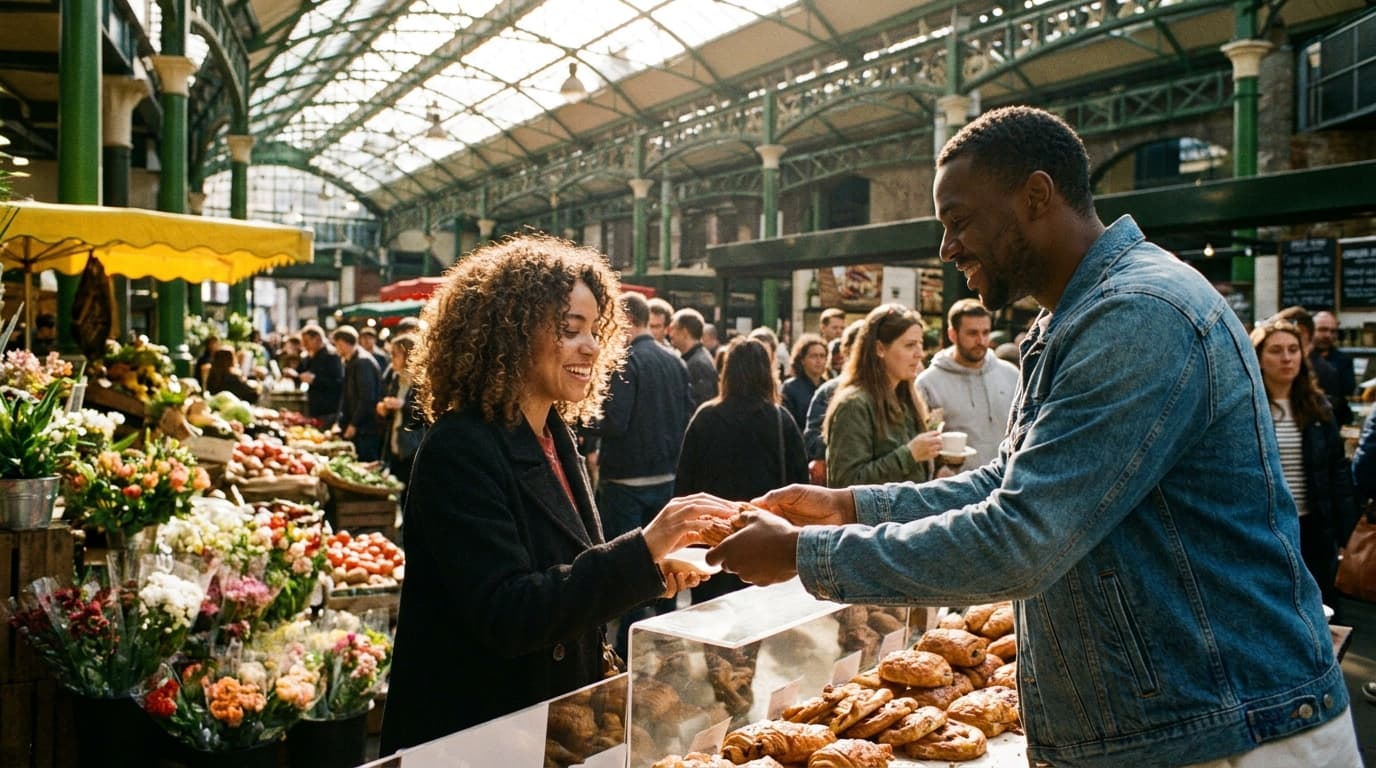
Broadway Market, Borough, Maltby Street, Columbia Road, Pop Brixton, Mercato Metropolitano. These work because they are slow, because food and drink make conversation easier, and because the same regulars come back week after week. They do not work if you arrive on your phone, walk through fast, and leave. They do work if you sit, eat, and read for an hour in the same spot, two weekends in a row.
Events and Rhythms That Actually Move the Needle
London is well covered by event listings, but most of the lists are not very useful for meeting people because they recommend big events where everyone arrives in groups. The events that work for dating-adjacent purposes have a different shape. They are small, recurring, and built around shared activity rather than passive attendance.
A few worth knowing about:
- Supper clubs and shared tables. Small group dinners around long tables, where seating is mixed and the format more or less forces conversation. Look at venues like Bonnie Gull, Brat, and St. John for cooking-led options; look at platforms like TimeLeft, Pop Bar Social, and Thursday's dinners for explicitly mixed groups of strangers.
- Lectures, debates, and bookshop events. The Conway Hall programme. The London Review Bookshop. The Bookseller Crow in Crystal Palace. Daunt Books on Marylebone High Street. The Hackney Picturehouse hosts regular author and film events. These attract the kind of people who go alone and stay to chat.
- Comedy nights in small rooms. Angel Comedy at the Camden Head. Top Secret Comedy on Drury Lane. The Bill Murray in Islington. The rooms are small enough that the bar before and after the show is functionally part of the show.
- Weekly social runs. Anything you can commit to weekly that does not require booking. The point is repetition. The fifth time you run with the same group is when actual conversations start.
The rhythm that pays off, more than any one venue or event, is showing up to the same place at the same time most weeks. London is full of people who go everywhere once. The people who go to one or two places many times are far more visible, and far more likely to be drawn into the small social ecologies that quietly form around regulars.
The Online Reality in London
For most people in London under forty, online dating is now the dominant route to first dates. Hinge, Bumble, Feeld, and a long tail of niche apps account for the majority of new relationships in this age group. The volume is so high that the city has effectively become a national stress test for online dating culture.
A few things are specifically true about online dating in London that are worth being honest about:
Volume is misleading. The apps surface enormous numbers of potential matches, but the quality of attention you can give and receive is finite. Most London users describe the same fatigue cycle: a burst of excitement, two or three weeks of high engagement, a long tail of conversations that fizzle, a quiet uninstall, a reinstall a few months later. Treating the apps as a tool you pick up deliberately, with limits on how long you spend, tends to work better than open-ended scrolling.
Geography matters more than the apps emphasise. A match who lives twenty minutes from you is dramatically more likely to turn into a real date than one who lives forty minutes away. Tightening your distance filter to your honest commute tolerance is one of the most useful adjustments most London daters never make.
Free platforms can be more honest about intent. Subscription-driven apps have a structural incentive to keep you swiping. Free platforms — including iwillfindyou.love, which has no paywall on messaging — tend to attract people who are there to meet someone rather than to maintain a habit. The signal-to-noise ratio is different, in a way that matters once you have spent a few months on the larger paid apps.
Suggest meeting earlier than feels comfortable. The single most reliable predictor of an online London match becoming a relationship is how quickly the conversation moved off the app. Two or three days of warm messaging followed by a specific suggestion — "I would like to get a drink. Are you free Thursday after work?" — outperforms three weeks of pleasant texting in almost every case.
First dates should be short, local, and easy to extend. A drink near a Tube station you both pass through. A coffee at a place with proper seating. A walk along the canal. London rewards low-stakes first meetings that can stretch into dinner if things go well and end gracefully in an hour if they do not.
A Practical London Dating Week
If you want a concrete example of what a deliberate dating life in London might look like, here is a sketch of a week that quietly puts you in the right rooms.
- Monday or Tuesday evening: A weeknight class or club — Italian language, life drawing, a beginner pottery course, a running group. Something that meets weekly and that you can stick with for at least three months.
- Wednesday evening: A drink in your own neighbourhood. Either with a friend at a local pub where you are slowly becoming a regular, or alone at a small café with a book. The point is visibility in a small space.
- Thursday after work: Either a date, or a small social occasion that puts you in mixed company. Industry meet-ups, alumni drinks, a friend-of-a-friend dinner.
- Saturday morning: A market, a slow brunch, a museum hour. Somewhere with proper seating, somewhere you go often enough to be recognised.
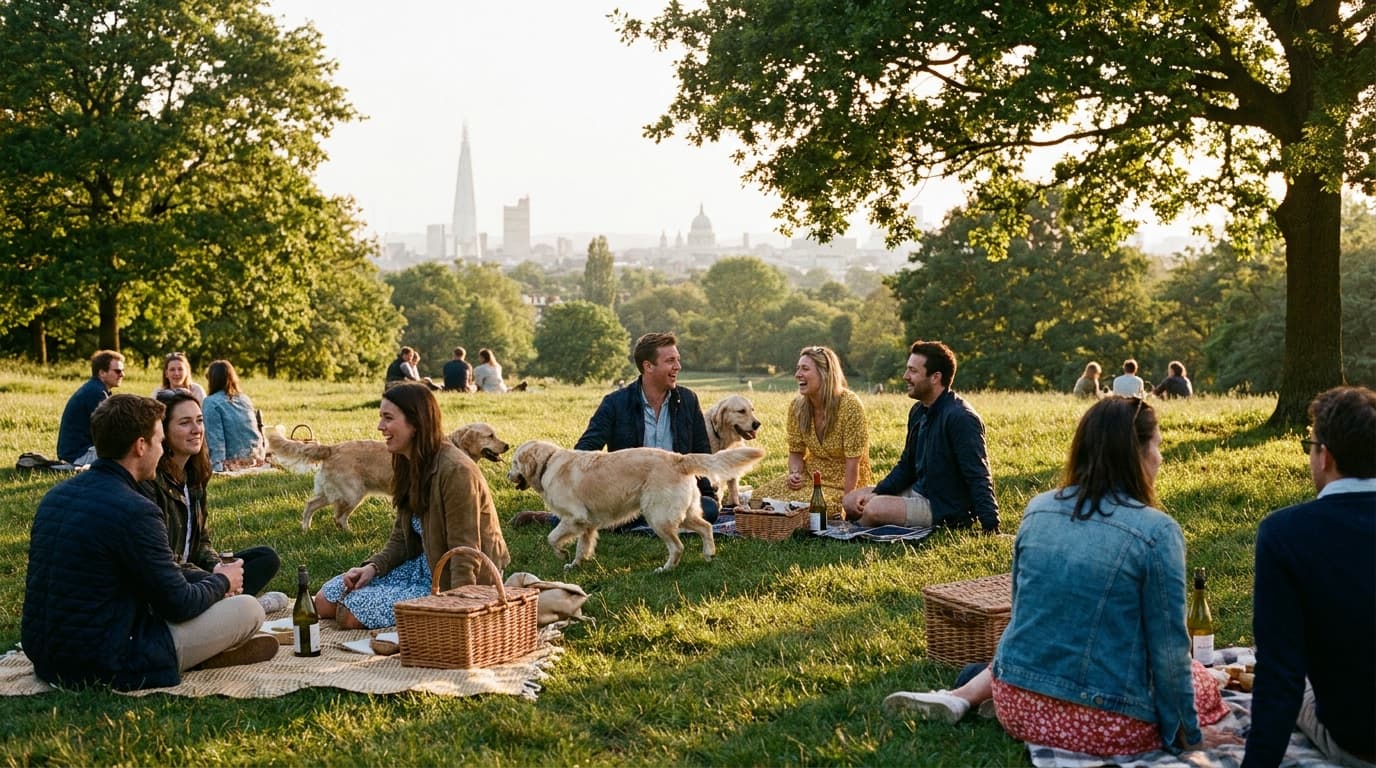
- Sunday afternoon: A pub roast in a room with tables close together. Bookshop browsing. A walk on the Heath, Hyde Park, Hilly Fields, or Hampstead Ponds in the right season.
This is not a programme. It is an illustration of a principle: the dating life that works in London is the social life that has shape. Three or four reliable touch points a week, all within a tight geography, sustained over months rather than weeks.
What to Do This Week
If you take only one thing from this, take this: pick a corner of the city you actually like, and start showing up there. Pick a Tuesday-evening class or a weekend-morning market in that corner, and commit to it for three months. Pair that with a deliberate hour a week on a free dating platform where the messaging is not gated behind a subscription.
The London dating life that works is not built on a single perfect venue or a single clever app. It is built on the steady accumulation of small, repeating presences in places you genuinely want to be. The city is full of single people. They are not hiding. They are simply also very busy, and waiting — like you — for somewhere to keep turning up.
When you do, the city starts to feel smaller, and the maths starts to work in your favour.
Further Reading
-
Sherry Turkle. Reclaiming Conversation: The Power of Talk in a Digital Age. Penguin Press, 2015. A foundational read on how digital communication shapes — and limits — our capacity for real-world connection.
-
Eric Klinenberg. Going Solo: The Extraordinary Rise and Surprising Appeal of Living Alone. Penguin Books, 2013. Particularly relevant for understanding how large urban populations of single adults actually behave.
-
Office for National Statistics. Marriages, Partnerships, and Cohabitation in England and Wales. https://www.ons.gov.uk. Useful baseline data for understanding the demographic context of dating in London.
-
Centre for London. London Intelligence: Demographics and Daily Life. https://www.centreforlondon.org. Regular reports on the social patterns of London life, including how Londoners spend their evenings and weekends.