
You open the dating app, tap on your profile, and there it is: the bio field, blinking and empty, waiting. You know you should write something. Everyone says a good bio makes a difference. But every time you stare at that blank box and try to summarise yourself into a few lines, you feel a creeping mix of awkwardness and writer's block.
If this sounds familiar, here is some genuinely good news: you do not need three paragraphs. You might not even need three sentences. A single, well-crafted sentence can do more for your dating profile than most people achieve with an entire paragraph of generic self-description. And writing that one sentence is something almost anyone can manage, regardless of how much you dislike writing about yourself.
Why Brevity Beats Length in a Dating Profile Bio
The instinct to write more comes from a reasonable place. More information means more context, which means better matches, right? In theory, yes. In practice, longer bios often work against the person writing them.
Here is what actually happens when someone lands on your profile. They spend about three seconds on your photos. If the photos catch their interest, they glance at your bio. At this point, a wall of text is going to lose most of them. Not because they are shallow, but because reading a detailed personal essay about a stranger requires an investment of attention that most people are not ready to give before they have even decided if they like your smile.
A single confident sentence, on the other hand, gets read every time.
It is also much harder to get wrong. Long bios create more opportunities for something to put someone off: an off-key joke, a slightly defensive disclaimer, a phrase that reads differently to different people. The shorter your bio, the fewer chances you have to accidentally send the wrong signal.
And there is something appealing about concision itself. A person who can sum themselves up in one compelling sentence signals self-awareness, confidence, and a comfort with ambiguity. Those are all attractive qualities.
The Hidden Power of Leaving Things Out
When you hate writing about yourself, part of what you are resisting is the exposure. Writing a long bio means making a series of small decisions about how to present yourself, each one feeling slightly vulnerable. What if they think this is boring? What if that sounds like I am showing off? What if this puts them off?
A short bio sidesteps much of that anxiety by leaving space. Instead of trying to pre-empt every question and head off every possible misreading, a one-sentence bio invites curiosity. It gives the other person something to respond to, something to ask about, something that opens a conversation rather than closing it.
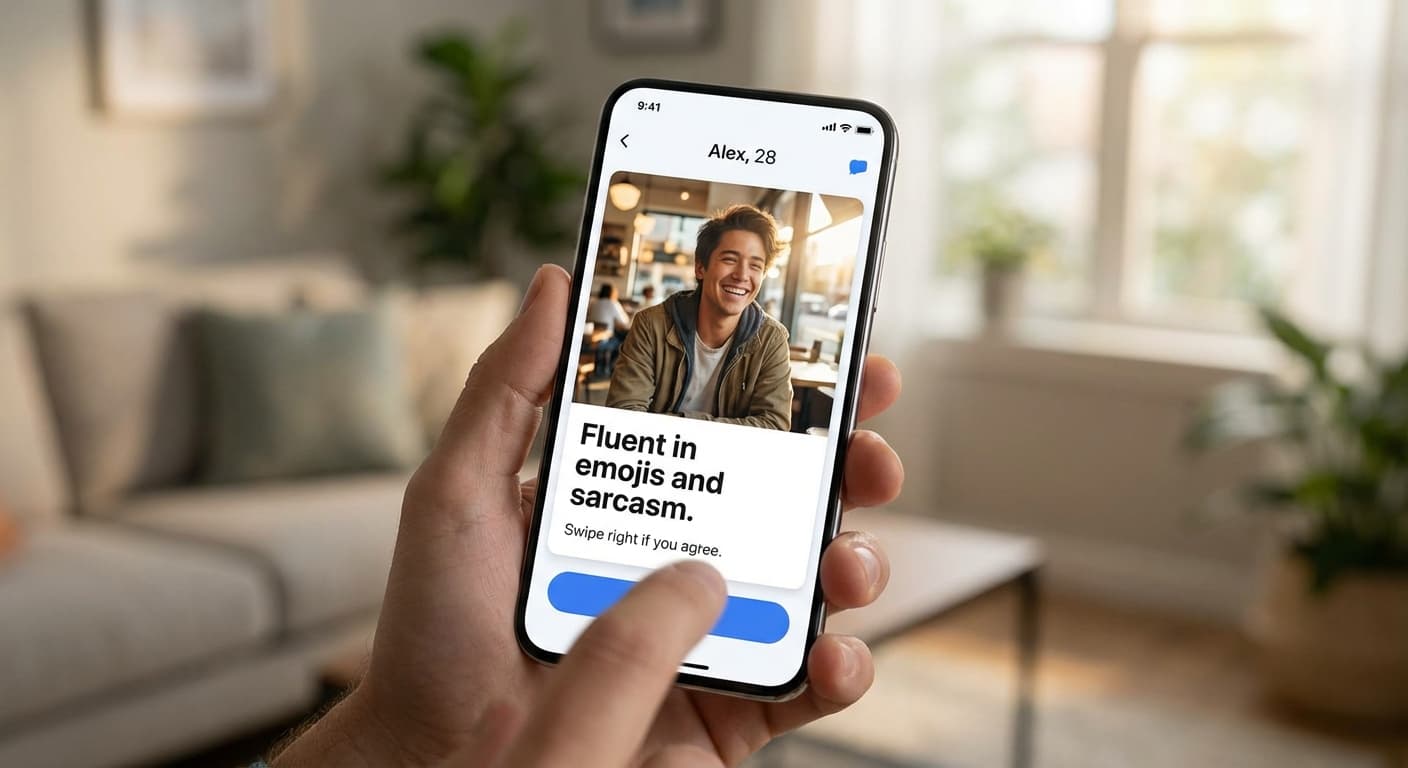
Think about the difference between these two approaches. The first: a six-line bio covering your job, your hobbies, your relationship goals, what you are looking for, your personality type, and a disclaimer that you are bad at this. The second: "I make excellent coffee and have strong opinions about where to put the apostrophe in 'its'."
Which one makes you want to send a message? The second gives you an immediate, specific thing to respond to. It reveals something about the person without cataloguing them. It suggests warmth and wit without announcing them. And it took about forty-five seconds to write.
What Makes a One-Sentence Bio Work
Not all short bios are effective. "Just ask" is technically a sentence, but it does not do any of the work a good bio should do. The goal is a single sentence that achieves several things at once.
It reveals something real
A good one-sentence bio is specific. Generic descriptors like "adventurous" or "loves to laugh" could apply to literally anyone and mean nothing. Specificity, even about something small, creates a point of genuine connection. "I adopt stray cats and pretend they found me, not the other way around" tells you something real about a person. It is also immediately relatable to the right person and gently filtering for others.
It creates an opening
The best one-liners end with a small gap that the right person wants to fill. A mention of a specific film, a slightly provocative opinion, an unusual hobby -- these all give someone an obvious and easy reason to reach out. "I have watched every Paul Thomas Anderson film at least three times and I have one controversial take" is an invitation. Almost anyone curious enough to message will want to know the take.
It has a voice
Your bio should sound like you. Not like a profile you read and liked. Not like what you imagine a good bio should sound like. If you are naturally dry and understated, be dry and understated. If you are warm and direct, be warm and direct. A bio that does not match how you actually communicate will only create a mismatch when the conversation starts.
It does not apologise
"I'm terrible at bios" is one of the most common lines on dating profiles, and it does real damage. It signals low self-confidence, it makes the other person do all the conversational work, and it wastes the only space you have to make a first impression. The temptation to lead with self-deprecation is understandable -- it feels safer than making a real claim about yourself. Resist it. Even "I make very average pasta but I'm working on it" is more charming and specific than a disclaimer about your bio-writing inadequacy.
How to Write Your One Sentence When You Have No Idea Where to Start
The blank page problem is real, and you cannot write your way past it by staring harder. Try this instead.
Think about the last three conversations where you felt most like yourself. Not impressive conversations, not first-impression conversations -- the ones where you were just at ease, talking about something you genuinely cared about or found funny. What were they about? Something in there is probably worth putting in your bio.
Think about what people consistently respond to when they first get to know you. Not your CV credentials. Not your most respectable traits. The actual things -- the enthusiasm about a specific topic, the weird area of expertise, the thing you always end up talking about at parties. These are often things you take for granted precisely because they come naturally.
Try the constraint game. Give yourself a limit: one sentence, maximum fifteen words. When you are forced to make choices, you often find the most honest version of what you actually want to say. Write twenty attempts in ten minutes without editing. Something usually emerges.
Steal from yourself. If you have ever written something that made a friend laugh, or a WhatsApp message someone screenshot and shared, start there. The version of you that writes naturally to people you are comfortable with is exactly the version you want on your profile.
Reading Your Own Bio the Right Way
Once you have a sentence, the question is whether it works. Here is a useful test: read it aloud to yourself and ask whether it sounds like you or like someone performing you. If there is a gap -- if it sounds slightly formal or slightly trying-too-hard -- it probably needs one more pass.
You can also ask someone who knows you well to read it and say the first thing that comes to mind. If they say "yes, that's you," you are probably there. If they say "hmm, kind of," go back to the constraint game.
What you should not do is optimise for breadth. The goal is not to appeal to as many people as possible. A sentence that is too hedged, too neutral, or too inoffensive in an attempt to not put anyone off will also fail to attract anyone. A bio that puts off nine people while making one person want to message you immediately is doing its job exactly right.
The Difference Between Simple and Empty
There is a version of the one-sentence bio that does not work: the kind that is brief but empty. "Here for a good time" is brief. "Looking for something real" is brief. Neither tells the other person anything they could not have guessed, and neither gives them a reason to message rather than scroll.
Simple is not the same as sparse. A single sentence should be pulling real weight. It should be doing the work of showing a glimpse of actual personality -- one specific, honest, memorable thing about you. If you can read your bio and imagine a hundred other people writing exactly the same thing, go back and make it more specifically yours.
Using the Rest of Your Profile
If your bio is doing its job in one sentence, the rest of your profile has less pressure on it. Your photos carry the primary visual story of who you are. Your answers to any profile prompts (if the app offers them) can add context on specific topics. Your bio is not responsible for everything -- it just needs to be the thing that makes someone feel that particular pull of curiosity and recognition that prompts them to reach out.
This is worth keeping in mind because one of the reasons people write long bios is that they feel the bio has to do everything. It does not. A profile is a combination of signals, and a short, confident bio surrounded by genuine, well-chosen photos is a strong combination.

Why Hating Self-Promotion Is Actually an Advantage
Here is the counterintuitive part. The people who find self-promotion uncomfortable tend to write better, more specific, more honest bios when they commit to being brief. The people who are comfortable writing at length about themselves often produce bios that are technically accomplished but feel vaguely like a sales pitch.
The discomfort you feel about writing a long bio is, in a sense, good taste. You know that cataloguing your qualities reads as slightly desperate or performative. The one-sentence bio gives you a way to be present on a dating platform without doing the thing you hate. One specific, honest line. No posturing required.
Getting Started on a Platform That Rewards Authenticity
A short, honest bio works best on a platform where genuine connection is the point rather than premium conversion. When you are on a free dating platform without artificial barriers to messaging, a compelling bio generates real conversation from real people -- not just algorithmic boosts or paid visibility.
iwillfindyou.love is built on the principle that authentic connection should not cost anything. You can write that one sentence, set up your profile, and start browsing and messaging without a subscription wall in the way. No tokens. No tiers.
If you have been putting off your dating profile because the bio felt like too much, consider that you may only need one sentence. The right sentence. The one that sounds like you on a good day, with something specific and real that the right person will want to respond to.
That sentence might already be somewhere in your recent messages, your most recent dinner conversation, or the thing you almost said in a group chat and then deleted because it seemed too niche. Go find it. It is probably better than anything you would write by trying.
Further Reading
-
Tyson, G., Perta, V. C., Haddadi, H., & Seto, M. C. "A First Look at User Activity on Tinder." IEEE/ACM International Conference on Advances in Social Networks Analysis and Mining, 2016. https://ieeexplore.ieee.org/document/7752279
-
Ellison, N., Heino, R., & Gibbs, J. "Managing Impressions Online: Self-Presentation Processes in the Online Dating Environment." Journal of Computer-Mediated Communication, 2006. https://academic.oup.com/jcmc/article/11/2/415/4617716
-
Fiore, A. T., & Donath, J. S. "Homophily in Online Dating: When Do You Like Someone Like You?" CHI Extended Abstracts on Human Factors in Computing Systems, 2005. https://dl.acm.org/doi/10.1145/1056808.1057043
-
Sumter, S. R., Vandenbosch, L., & Ligtenberg, L. "Love Me Tinder: Untangling Emerging Adults' Motivations for Using the Dating Application Tinder." Telematics and Informatics, 2017. https://www.sciencedirect.com/science/article/pii/S0736585316301216